What is grid-scale battery storage? A plain guide for Japan
How grid-connected batteries work, how Japanese rules treat them, and why applications have surged since 2024.
Key takeaways
- A grid-scale battery is a large battery facility connected directly to the power grid that stores electricity when supply is plentiful and releases it when the grid needs it.
- Japan's 2022 amendment to the Electricity Business Act treats discharging from a grid battery of 10,000 kW (10 MW) or more as a power generation business.
- Contract applications for grid batteries in Japan reached about 24 GW at the end of September 2025, about 3.9 times the level a year earlier, according to the Agency for Natural Resources and Energy (ANRE).
- Batteries can take part in Japan's balancing market, capacity market and Long-Term Decarbonization Auction (LTDA).
- Grid-connection rules for batteries tightened in 2026, so secure land and realistic grid plans are becoming more important.
What is a grid-scale battery?
A grid-scale battery is a large battery facility that connects directly to the electricity grid. It charges when there is more power than the grid needs and discharges when demand is high or supply is short.
These facilities are often called battery energy storage systems (BESS). In Japanese policy papers they are called grid batteries (系統用蓄電池). ANRE explains that, unlike a battery installed next to a solar or wind plant, a grid battery is connected to the grid itself. It responds to supply and demand across the whole power system rather than to the output of one plant.
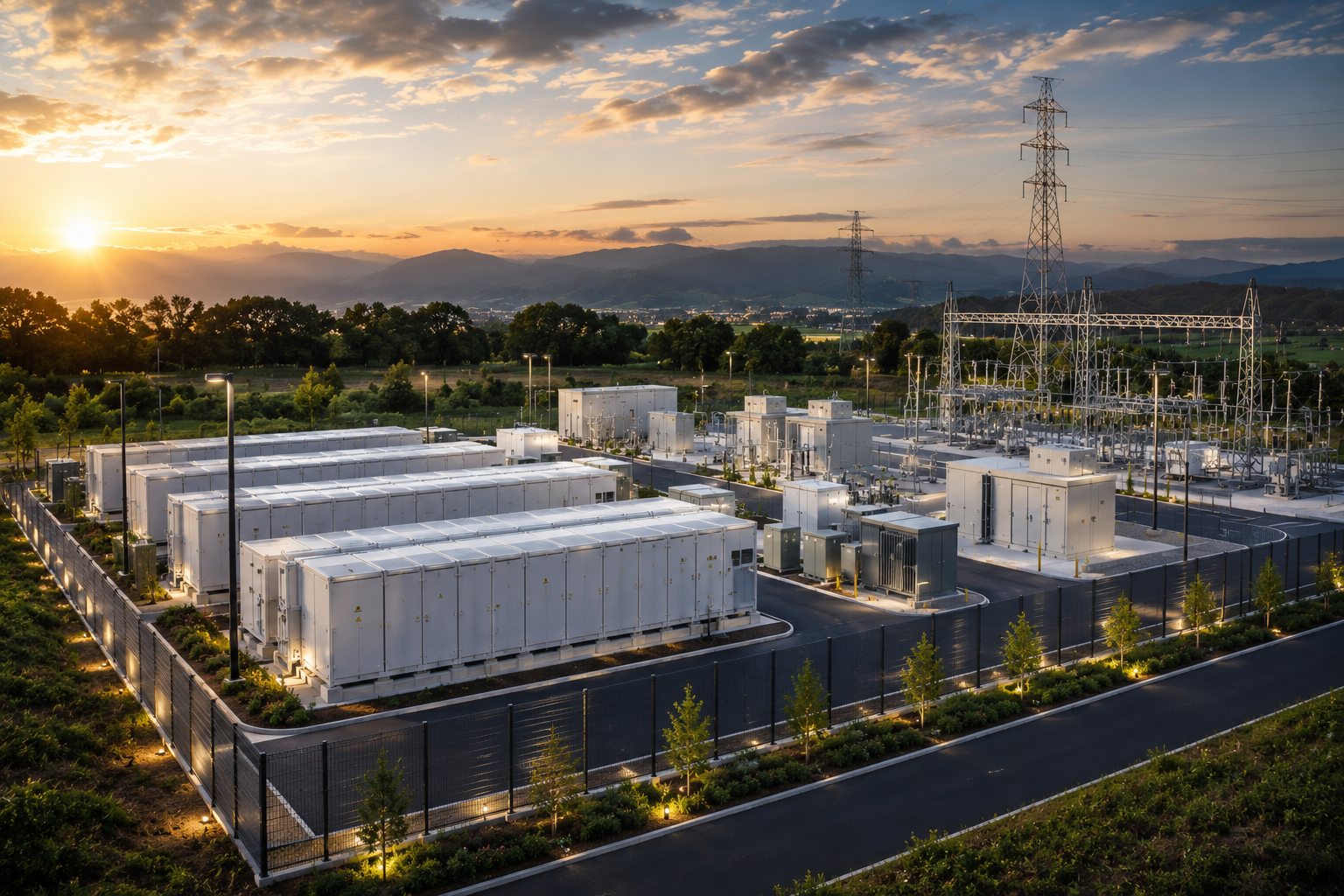
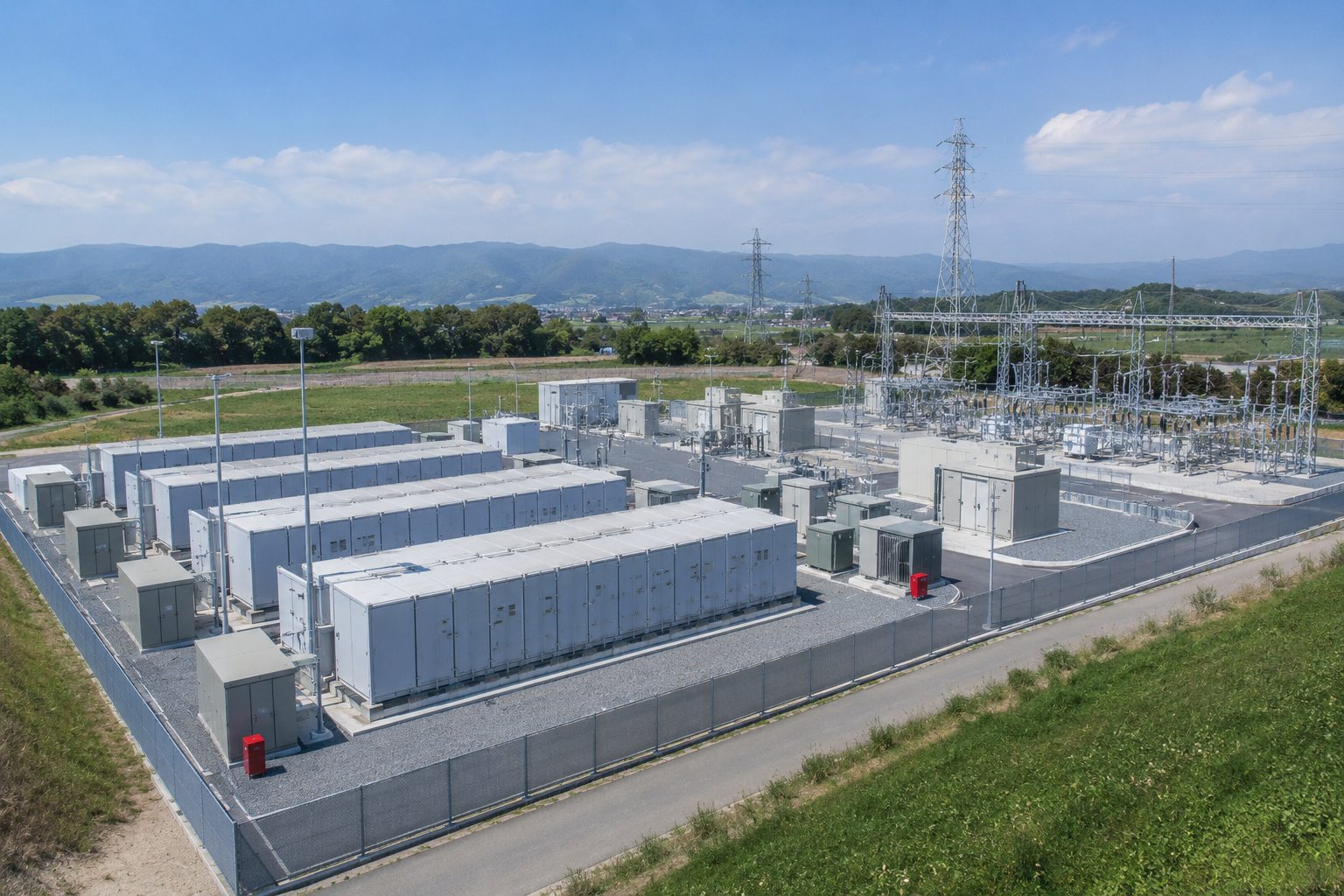
A typical site has four main parts. Battery modules store the energy. A power conversion system turns direct current into alternating current and back. A battery management system watches cell voltage and temperature. Finally, a transformer and substation link the site to the grid.
Power and energy: MW and MWh
Every grid battery has two sizes. Power, in megawatts (MW), is how fast it can charge or discharge. Energy, in megawatt-hours (MWh), is how much it can store. Divide energy by power and you get the duration: a 10 MW / 30 MWh battery can discharge at full power for about three hours.
The International Energy Agency (IEA) reports that most projects worldwide still cluster around two hours, but a growing number offer four hours or more. It also reports that lithium iron phosphate (LFP) batteries made up around 90% of deployments in 2025.
How does a grid-scale battery work on Japan's grid?
A grid battery moves electricity from hours of surplus to hours of need. In Japan, the clearest example is charging on surplus midday solar power and discharging it in the evening, when solar output falls.
Without storage, grid operators sometimes have to reduce solar and wind output. This is called output curtailment (出力制御). ANRE's December 2025 report says curtailment has spread to areas across Japan. In Kyushu, the curtailment rate for variable renewables was 8.3% in fiscal year (FY) 2023 and 4.8% in FY2024. That equals about 1.29 TWh and 0.75 TWh of curtailed electricity.
A battery that charges during those hours can deliver the same energy later. Batteries can also respond very quickly, a feature ANRE highlights when discussing supply capacity and balancing. A government-commissioned study from FY2022, cited by ANRE, lists the main uses: avoiding imbalances, avoiding curtailment, and supplying balancing and supply capacity through markets.
How does Japan regulate and support grid-scale batteries?
Japan now treats large grid batteries much like power plants. The 2022 amendment to the Electricity Business Act made discharging from grid batteries of 10,000 kW or more a power generation business, subject to rules similar to those for generators.
Several market mechanisms are open to batteries. ANRE describes them in its May 2024 paper on grid batteries, summarized below.
| Mechanism | What it procures | Battery data point |
|---|---|---|
| Balancing market (需給調整市場) | Reserves that transmission operators use to control frequency and balance supply and demand | Procurement started with tertiary reserve products in FY2021 and FY2022; the other products started in FY2024 |
| Capacity market (容量市場) | Future supply capacity, measured in kW | Batteries bid 80,000 kW, or 0.05% of the total, in the FY2023 main auction for delivery in FY2027 |
| Long-Term Decarbonization Auction (長期脱炭素電源オークション) | New investment in decarbonized capacity, with capacity payments at a fixed-cost level for, in principle, 20 years | In the first round (bids in January 2024, results in April 2024), batteries won 1,092,000 kW out of 4 GW sought for decarbonized capacity |
Under the LTDA, winning projects receive capacity income but hand back about 90% of their other market revenues. The design aims to make long-term income more predictable for large up-front investments. Market rules change often, so check the latest documents from ANRE and the Organization for Cross-regional Coordination of Transmission Operators (OCCTO) before relying on any detail.
How fast is grid-scale storage growing in Japan?
Interest has grown very quickly. At the end of March 2024, grid battery connection reviews totaled about 40 GW and contract applications about 3.3 GW, roughly three times the level of May 2023, according to ANRE.
By the end of September 2025, contract applications nationwide (excluding Okinawa) had reached about 24 GW. That was about 3.9 times the level a year earlier. For comparison, solar applications grew about 1.1 times and wind about 0.8 times over the same period.
Applications are not the same as projects in operation. ANRE notes that not every connection review leads to a grid connection. Battery operators it interviewed also said many contract applications have an uncertain chance of being built.
For the longer term, ANRE's 2024 paper cites an outlook of about 14.1 to 23.8 GWh of cumulative grid battery capacity in Japan by 2030. Globally, the IEA reports that 108 GW of new battery storage was deployed in 2025, 40% more than in 2024.
What should landowners, partners and investors watch next?
The main thing to watch is grid access. Because applications rose so fast, Japan introduced stricter rules in 2026 to discourage applications that reserve grid capacity without a real plan to build.
- From April 2026: as a temporary measure, grid battery contract applications received from April onward face a higher deposit and stricter rules for paying grid reinforcement costs in installments.
- From August 1, 2026: ANRE's April 2026 paper gave this as the planned start of a cap on the number of pending connection reviews one company can hold in each transmission area.
- Longer term: ANRE is studying a non-firm connection model for battery charging, which could let batteries connect without reserved grid capacity if they accept charging limits during congestion. ANRE estimates it will take 5 to 7 years to introduce.
For landowners, this means land with a clear grid route and secure rights is more useful than before. You can read how we approach site acquisition and grid interconnection, see our projects and pipeline, or tell us about your land.
Frequently asked questions
Is a grid-scale battery the same as a home battery?
The basic chemistry can be similar, but the scale and role are different. A home battery serves one household behind its meter. A grid-scale battery connects to the transmission or distribution network and supports supply and demand for the wider system.
Does a grid battery produce electricity?
No. It stores electricity that was generated elsewhere and releases it later, with some losses. Even so, Japanese law treats discharging from grid batteries of 10,000 kW or more as a power generation business.
How long can a grid battery discharge?
It depends on the ratio of energy (MWh) to power (MW). The IEA reports that most projects cluster around two hours, while more new projects offer four hours or longer.
Are grid-scale batteries safe?
Safety depends on design, monitoring and operation. Common measures include battery management systems, fire detection and suppression, spacing between units, and planning with local fire services. Our safety and community page explains the measures we use.
Sources
- IEA, "Global Energy Review 2026: Technology: Battery storage" (2026)
- Agency for Natural Resources and Energy (ANRE), "系統用蓄電池の現状と課題" (Current status and challenges of grid batteries), Material 5 (May 29, 2024)
- ANRE, "系統用蓄電池をはじめとする発電等設備の迅速な系統連系に向けた対応について" (Measures for faster grid connection of grid batteries and other facilities), Material 1-1 (February 9, 2026)
- ANRE, "系統用蓄電池をはじめとする発電等設備の迅速な系統連系に向けた対応について" (Measures for faster grid connection of grid batteries and other facilities), Material 2 (April 16, 2026)
- ANRE, "再生可能エネルギー出力制御の短期見通し等について" (Short-term outlook for renewable energy output curtailment), Material 1 (December 24, 2025)